Friday, September 29, 2017

Doctrine of Necessity from CJ Munir to Judge Khosa: Role of Judiciary in the Service of Neocolonialism

We need to compare the Doctrine of Necessity version 2.0 of SC Justice Khosa (2017) which states "To do a great right, do a little wrong" with the Doctrine of Necessity version 1.0 of  SC CJ Munir (1954) which states "Necessity makes lawful that which is unlawful". As per SC decision of March 2012 "deciding cases on the basis of likely consequences will mean reverting to the malignant ‘doctrine of necessity’ that has been buried by the people with their valiant struggle" [1]. It is clear that both version 1 and 2 are relying on the "likely consequences" emanating from a "great right" and "necessity". Since 1954, Doctrine of Necessity Version 1.0 has been responsible for sending home 15 prime ministers, imposition of 4 martial laws, and slapping of dictatorial rule of over 35+ years. Effectively over the last 63 years, the doctrine seems to have only served the interests of neo-colonialism, and has neither served any great necessity or delivered any great right (see Costs of Justice Munir's Doctrine of Necessity: 4 Martial Laws and 35 years of dictatorships). As per the comments of Justice Khosa and Justice Ejaz Afzal, Panama Case Judgement would be remembered for decades and centuries. Hence, the questions raised by Doctrine of Necessity version 2.0 are  (i) How many PMs will this decision depose? (ii) How many martial laws will it germinate? (iii) How many years of dictatorial reign will it perpetuate???
[To understand the context of this post, please read At What Cost! Why Compute Economic Costs of Faulty Political Decisions]

Sunday, September 24, 2017

Myth: Government Universities Cost Less than Private Universities

This post explores the myth that Public Universities Cost Lower than Private Universities. I think the average cost per student per year of a public university is much more than that of a private university. Given below is a preliminary analysis. A more detailed analysis is required.
2005-2006 Analysis of Public sector universities indicates that:
  • HEC funding per student (2005-6) ~ Rs 75 k 
  • Additional fees paid per year per student
    • Typical fee: ~ 25 k (For universities like KU) 
    • Exorbitantly: ~ 150 k (IBA, NUST) 
  • Total Average cost per year = 100k – 225k 
  • Land acquisition and capital investment through PC-1s and other external funds would be extra and would amount to hundred of millions of rupees of funding per year to each public sector university.
Private Sector HEIs in 2005-06 in Karachi were typically costing a student less than Rs. 100 k. Mind you these universities took not a single penny from the tax money collected from the poor!

[2012]
In 2012, the average cost per student per year had climbed up for many public sector universities to over Rs. 200k. Whereas, many private sector universities in Karachi had fees around half. Remember, this would include operational costs as well as capital costs. Whereas the Rs.200k per student per year operational
costs of public sector universities does not include capital and development costs, which is an additional tab to be picked up by the poor taxpayers.

[2015-16]
According to the budget documents Rs 79.5 billion has also been earmarked for Higher Education Commission (HEC) including Rs 21.5 billion under the Public Sector Development Program (PSDP) and Rs 58 billion on account of current expenditure, showing an increase of 13 percent as compared to Rs 51 billion earmarked for 2015-16. [1]

The amount comes to around Rs 200k per student for on-campus students of government universities. Please note that this does not include the land grants and other allocations. This is directly from the federal budget.

The per student cost of a government university must also include the cost of all the officials of all the ministries responsible for making the government universities work. This cost should also include:
  1. Cost of HEC personnel, administration, staff and operational costs responsible for calculating, approving, sanctioning, monitoring of any funding requirements for the government universities.
  2. Cost of all the accreditation bodies for Engineering (PEC), Business (NBAEC), Computer Science etc. I think currently there are over ten such bodies and many others are in the process of formation. Their operational costs must be computed and distributed over the public universities. This function in US and other countries is typically performed by independent professional bodies with little or no tax money involved. 
  3. Cost of Ministry of Finance, AGPR, Planning Commission and other ministries responsible for disbursements of operational budgets, pensions, sanctioning and monitoring of PC-1s and their funds, decision making etc. 
  4. Cost of provincial departments and Governor secretariat's responsible for sanctioning of leaves, appointments, projects planning etc. 
  5. Cost of all the capital investments through land allocations, grants, funds through other government agencies. 
  6. Cost of all the USAID and development funds loans and advances along with their interest payments
You add up all these costs and you will find out that the total cost per student per year, can come out to be at least ten times the per student cost of the private universities. Please note once again the private universities are not using the tax money of the poor people.

Now the justification of all these costs is on the basis of social equality and equal opportunity for the poor people of Pakistan. There are two major arguments:
  • There are many public universities whose fees are much more than several private universities. This should not be allowed. Example, IBA's cost is Rs 150k per semester which is much more than most private sector universities. 
  • Why can't the government calculate all the money that it is spending on the public universities divide it by the number of poor students that it wants to support and give that as a hardship scholarship vouchers to the poor students. Let the poor students shop around for a university that would let them study with that voucher. I think this may be a more equitable distribution of money. It would then be channeled to the more efficient universities who can give the best quality for the least amount of money. This is how the market dynamics play out. 
Consider this: Before HEC (2002-03) a government university like IBA Karachi's fee was Rs 24k/sem, and new startup private universities were charging around Rs 40k/sem. After HEC's advent today the government IBA fee is Rs 216k/semester, and new private universities are charging from Rs 4 lacs/semester to Rs 6lacs/semester. What is happening? This is the impact of not counting the costs. HEC effectively has become an institution that has raised the entry barriers and has reduced access to both the private universities and to the government universities. More on this in a later post.

References:

[1] Report

This write-up is an extended rehash of the ideas presented in a talk on "Five Major Myths of Higher Education" made at the CIO Conference, March 2009 at Sheraton, Karachi. See another link.
Presentation originally made at CIO Conference, March 2009 at Sheraton, Karachi.
The links and write-up below is an extended rehash of those thoughts:

Myth #1: Our backwardness is because we lag behind in Science and Technology
Myth #2: There is mushrooming of Higher Education Institutions in Pakistan
Myth #3: Impact Factor research measures real impact
Myth#4: Myth and Fiction of Government Universities Costing Less than Private Universities
Myth#5: Bigger infrastructure (land, building, equipment) means better education
asdfasd

See Other Posts on Higher Education

Sunday, September 3, 2017

How Readers are Created. Ecosystem that Produces Readers

How can we create readers and an ecosystem where readers can thrive. How do we make reading a contagious disease when our educational institutions from schools to universities have become mass producers of functional illiterates [1]. Universities complain that they are getting intake that has studied English for 12 years but have no reading comprehension and no expression. The employers are complaining that graduates coming out of the universities can not even write a single page of correct English. This is a dismal situation. How come we are producing functional Illiterates who are defined as people who know how to read but are not readers, and those who know how to write but are not writers! How can we reverse this?

Friday, September 1, 2017

How Literature Review of a PhD Dissertation Presents the State of the Art: Synthesis vs Listing

Quality of literature review is what majorly differentiates a PhD Thesis from an MS Thesis. The qualitative difference is in the digestion and synthesis of the existing work into a framework on which your research contribution and sequence can stand. This synthesis of existing work in the topic area should itself be worthy of a publication. Digestion of the existing papers is represented by a list of factors or parameters that you have identified on which you can compare and and contrast the existing literature. Not all parameters are relevant to all the papers. Hence, parameters are separated into different subsets. For each subset, a table can be constructed through which papers relevant to the subset parameters can be compared and contrasted. Analysis of these parameters provide you with the explanation of the gap or the problem area which is then articulated in the form of a problem statement.

Thursday, August 31, 2017

Facebook Encourages Unethical Behavior: Metaphysics of Social life based on Lies, Ignorance, Bigotry

Why social media has become the primary source of fake news. Why people in social media communities are likely to become extremists, bigoted, and unlikely to hear or see content that is against their beliefs. Technology is not value neutral. It comes with its own baggage of values. Facebook, Whatsapp, twitter have enabled the technology that gives voice to the baser instincts of humans. It has provided a platform for mass dissemination of lies, fake news, slander, false allegations, lampooning, extremism and bigotry by removing the social costs of these vices. It has disconnected the responsibility of the people from their speech and behavior. Identities of person who have been complicit in the generation of fake news and slander are now hidden. People who started the rumor are no longer easy to identify, trace and track. There is a need to do research on the metaphysics of social media: Lifestyle of social media determines its own metaphysics, which creates its own intentions and generates its knowledge as described in the post  From Lifestyles to Metaphysics

Wednesday, August 30, 2017

How Schools Teach Students to Hate Reading: Mass Creation of Non-Readers

Schools are producing graduates who know how to read but are not readers. They have become non-readers (functional illiterates) because the schools have taught them to hate reading! 
Functional Illiteracy
Schools typically use a curriculum and methodology that consists of senseless and meaningless worksheets and exercises which the students are forced to do repeatedly, continuously and ad-nauseam. And, when they resist, they are punished with F-grades, labeling and humiliation. These meaningless tasks and exercises and their resulting punishments teaches the students to hate reading and convinces them that ALL reading is so tedious, so boring, so frightful and accompanied with so much punishment that it is inconceivable that reading can ever be pleasure and fun. This is how we are producing non-readers, who believe that reading books is unreal, irrelevant, and disconnected with the challenges of life. We are in fact producing functional illiterates. 

Life Long Learning vs Sacrificing Interest
at the Altar of Technique Mechanics

Sunday, August 27, 2017

How to become a Life-Long Learner: Mission of Developing Life-Long Learners

This is the first orientation of new students of IoBM over the last 23 years, where our founder president, Mr Shahjehan Karim is not present. He left us for the hereafter last month. Inna lillahe wa inna ilaihi rajioon. He worked tirelessly all his life to make a world a better place. This institution of IoBM is a testimony to his vision, his mission and his aspirations. One can talk about his achievements for hours. But, today at the Orientation for New Students,
I will focus on one single point; the mission and purpose of IoBM. Mission of an organization is the reason d'etre of why the organization exists. One can see in the following mission statement, Mr Shahjehan S Karim's love for learning, love for the youth, and through them his hopes and aspirations for the future: "The mission of the Institute of Business Management is to foster a learning environment where students are motivated to make learning an on-going life-long process. "
[Aug 26, 2017]

Friday, August 25, 2017

What is a Problem Statement and its role in MS-PhD Research

I am coming across research proposals and dissertations where there is a section heading called "Problem Statement" under which you find several paragraphs containing everything except the "Problem Statement"! The problem statement seems to be embedded somewhere in these several paragraphs but never crisply, precisely stated in a single sentence. Statement is ONE sentence. The problem statement is one sentence that describes why your research and your thesis exists. If you do not have a convincing problem statement describing the gap that requires to be filled, then there is no need for you to research! "Problem Statement" identifies the problem that you are solving, the gap that you are going to fill, the ontological "contribution" that you are going to make via the "original" research of your thesis. Unfortunately, an imprecise and vague description of the problem statement often creates a huge issue during the defense, because the examiners may not understand or buy into the problem as it was not precisely stated and not articulated convincingly.


Monday, August 21, 2017

What is a Thesis Statement and its Role in PhD-MS Research

My supervisor JC Browne at the University of Texas at Austin during 1990-1993 made me write the problem statement and the thesis statement for every research paper that I would read for my literature survey. Since early 2000s, when I started supervising my research students, I have also found the "Thesis Statement" extremely useful in focusing the researchers on the essence of the problem that they are solving and how their "thesis statement" presents in a single sentence the essence of what they have done in their research and why. Effort that I have put in with my research students in developing a precise articulation of thesis statement of their research or of the paper that they are reading or writing has revealed to me several benefits which were not visible to me when I was a student. Most important of these include:


Sunday, August 20, 2017

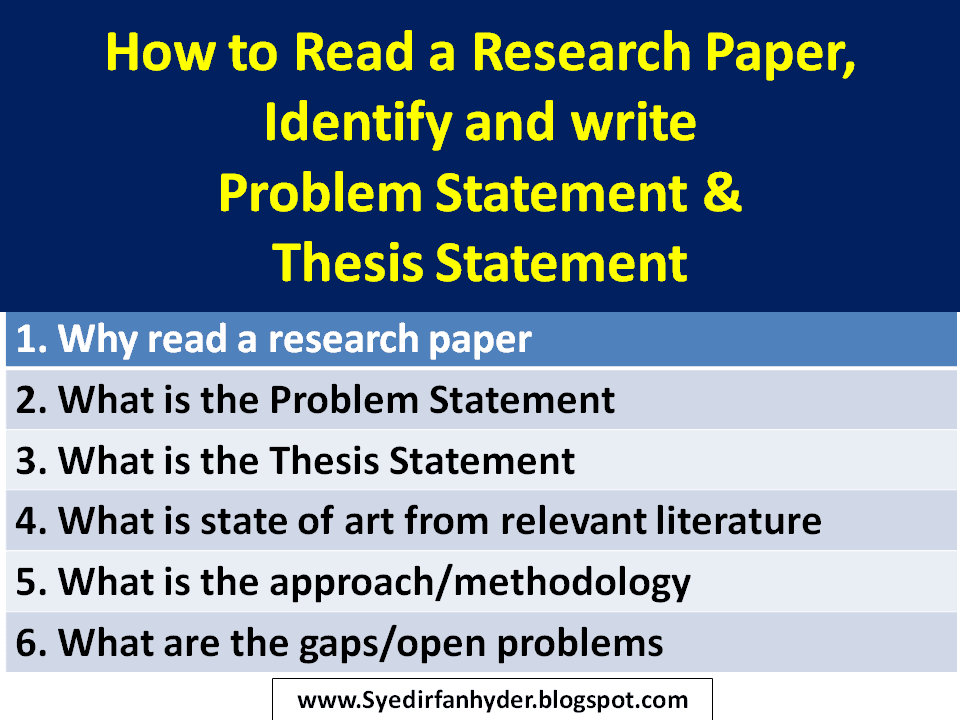
How to Read a Research Paper and Extract Problem Statement and Thesis Statement

Based on my experience of research supervision since 2002, I can safely say that if you do not know how to read a technical research paper and from it identify the problem statement and thesis statement and write them in a convincing readable manner then it would be difficult for you to complete your MS/PhD thesis. I strongly urge my research students to understand this process. This would help you to articulate the problem statement and the thesis statement of your MS/PhD research. These two statements define the scope of your research and also serve as the bulwark of your eventual defense in front of the thesis evaluation committees.

Thursday, August 17, 2017

How to Develop Personal Brands from Your Leadership Identity

Developing personal leadership brands is a lifelong quest for self-discovery, self-realization and self-actualization. It starts from your personal discovery of what is leadership and from there carving out your leadership identity which is about your "value proposition": The value that you are going to add to your work, to your relationships and to your life. You then become an embodiment of this "value" that should be seen, be heard and be read.

Saturday, August 12, 2017

What Legal Questions Perry Mason would have raised in SC Panama Case Disqualification of PM

Why read literature and history?
It had been a great surprise for me that the lawyers representing the PM have failed to raise forcefully some basic and fundamental questions about due process of law and constitutional rights in the recent  SC disqualification of the PM in the Panama Case Judgement. Interestingly, if they had read Perry Mason and other books of literature they would have  been better able to respond to the literary challenge of Judge Khosa! Their ignorance about history and literature was also telling in their defense. The lawyers failed to raise several objections forcefully during the proceedings as well as during the JIT investigations that a laymen reading of Perry Mason could have provided. Their ignorance about Islamic and Legal injunctions about due process of law was also evident. Even in the review petition, lawyers should note that literature can only be rebutted with literature, Islamic injunctions can only be defended through Islamic Fiqh, poetry can only be rebutted through poetry, accounting issues can only be defended through accounting principles, tax returns can only be defended through tax laws, and history can only be argued with history.  Legal arguments need to be of course rebutted through constitution and law, even in that which they were seriously amiss:

Tuesday, August 1, 2017

SC Judgement as Project Assignment for Finance Accounting Students: SC Disqualifies PM on not Declaring Uncollected Receivables as Income

Finance, Accounting and Taxation Teachers: SC Judgement invoking uncollected receivables can be a very interesting project assignment for accounting, taxation, finance and business students. This assignment will bring alive accounting and finance to the students and would tell them the difference between personal and corporate accounting, tax laws, income and receivables and uncollected receivables.

Saturday, July 29, 2017

SC Interpretation of Sadiq and Ameen in Disqualification of PM Nawaz Sharif

PM Nawaz Sharif has been disqualified from being the prime minister as per Pakistan's constitution for not being "honest" using the concepts of Sadiq and Ameen.  It is important for the followers of law and constitution to see the debates related to how courts have interpreted these concepts and how they have internalized these concepts through several judgments. 
In 28 July 2017 disqualification of PM Nawaz Sharif, supreme court judgment states: 

Saturday, July 22, 2017

Can Corruption be Eliminated by Hanging a few Thousands through Panama Case like Judgements

[To understand the context of this post, please read At What Cost! Why Compute Economic Costs of Faulty Political Decisions]
It is worrying to see the sentiments of educated people and the functional illiterates (those who know how to read but are not readers) on the social media clamoring for the head of the PM and his family. They want an immediate decision and seem to have no patience for the "niceties" of "due-process-of-law" to be followed. They are shouting, screaming, cheering for the heads of PM and those related to him for the "crime of being rich". The crowds are being led and encouraged by those educated whose sentiments seem to have more in common with Robespierre during French Revolution.  It is interesting to compare the emotions of people clamoring for the head of PM to the mobs/crowds during "reign of terror" in 1793 France screaming "off with the heads" of the rich. Heads of thousands of aristocrats were chopped off by the guillotine for the crime that their hands were soft (meaning that they were not working with their hands) which implied that they were rich. This mood was then captured by Balzac in his famous quotation which was used by SC Judge Khosa "Behind every fortune is a crime" in Panama Case Judgement.  Balzac was an inspiration for Marx and Engels who were the inspiration behind the communist revolution in 1917 of Soviet empire that outlawed all individual enterprises and enforced "equality" of salaries and perks for all the jobs. Interestingly, this emphasis on artificial equality became the famous satirical expression "all are equal but some are more equal than others" that became the death knell for the demise of communism and Soviet Empire.

As I see the popular frenzy of the youth and educated on the media asking urgently for the head of the PM and ignoring and dispensing the requirements of due process of law, I am reminded of the Reign of Terror in France in 1793. I also connect it to the reference of French author in the SC Judgement of April 20 which starts with Judge Khosa's judgement that is spread over 200 pages and quotes Honore De Balzac "Behind every great fortune there is a crime" and then goes to condemn the rich using Shakespeare's Merchant of Venice quote: "To do a great right, do a little wrong”. Balzac was born in 1799 just a few years after the "Reign of Terror" and must have carried the emotions and sentiments of the crowds screaming "off with the heads" under the leadership of Robespierre with scant regard to due process of law.
This Balzac's statement "Behind every great fortune there is a crime" is categorical and is condemning all the wealthy people, a-priori, without trial and is thus a highly problematic concept to be relied upon in a court of law, and that too by Supreme Court which is going to make it quotable for decades to come. Fortunately, this view was rejected by the majority of the supreme court judges on the bench 3-2. The majority held that a person can not be convicted by an appellate court (SC) without due process of law in a trial court followed by his right to appeal.

It is interesting to note that Balzac emphasized class conflicts and inspired the revolutionaries and Marxists who hated the rich and gave birth to socialism and communism ideologies which emerged from Marx and Engels:
Marxist Friedrich Engels wrote: "I have learned more [from Balzac] than from all the professional historians, economists and statisticians put together".[128] [Wikipedia]
On the other hand irony of PM's situation in SC  can be seen as a great "Makafaat-e-Amal" as he tries to defend himself after the submission of JIT Report. His counsel is fighting to get the "fundamental rights of due-process-of-law" for the PM. Those rights that are trampled upon daily by the police and LEAs (euphemism for overt and covert agencies in Pakistan); LEAs routinely handcuff the common people for extortion and bribes, often forget the suspects after throwing them in jail for years, kill them in blatantly contrived police encounters and subject them to "forced disappearances" about which even SC can't do any thing, ..... I believe it is the pent up emotions of this deep sense of injustice in our society that has led to the situation that is resembling the time before the "Reign of Terror".

PM's attorneys are struggling to get the following rights from SC.
1. Right to a fair and open trial
2. Right to due process of law, getting charged first before being sentenced.
3. Right to be held "innocent unless proven guilty".
4. Right to a defense attorney during deposition.
5. Right to be presented with evidence and cross examine the evidence by their attorney
8. Right to cross examine the witnesses by their attorney.

Pakistan nearing this stage where educated and the energetic youth are clamoring for the heads of rich and are willing to violate the due process of law in their haste is really terrifying:
During the period of the French Revolution, and especially during the Terror (1793-1794) when the state enacted martial law, use of the guillotine skyrocketed. Led by Maximillian Robespierre, the Committee on Public Safety enacted a series of decrees that established a system of Terror, enforced by the state, in an effort to root out counter-revolutionaries and save the new Republic from itself.
Under this system, at least 40,000 people were killed. As many as 300,000 Frenchmen and women (1 in 50 Frenchmen and women) were arrested during a ten month period between September 1793 and July 1794. Included in these numbers were, of course, the deaths of Louis XVI and Marie Antoinette. Although all social classes and professions were targeted, the death toll was especially high for both clergy and aristocrats. The numbers of those killed and taken into custody were probably even higher as the documented numbers don’t include people killed by vigilantes and other self-proclaimed representatives of the Republic.
I believe that under no circumstance the demand for quick and instant justice from mobs and crowds and the pressure of popular sentiments should dictate the decision of Supreme Court of Pakistan. It would be disastrous for Pakistan. As we have seen that political issues can not be resolved through SC judgements. Gen Zia the dictator who toppled the government of Bhutton in 1977 tried to solve the problem of ZA Bhutto, the deposed PM, potential political protests through a contrived SC judgement on a criminal case of murder. He was hanged in 1979 as per the SC judge. The consensus today points towards the Supreme Court also admitting that their were serious lapse of the "due process". Popular opinion now considers the judgement as the "Judicial Murder"

See other posts on Corruption: 

  1. Can Corruption Problem be Solved by Hanging a Few Thousands?
  2. Can Corruption be Eliminated by Hanging a few Thousands through Panama Case like Judgments
  3. Corruption is a cause or symptom of Government Inefficiency- Challenge for Imran Khan
  4. Covey's First Habit Advice to Proponents of Corruption Eradication First 
  5. How Corruption is being Eliminated in Pakistan since 1950s: Corruption as a Ruse to Maintain Status Quo
  6. How to Eliminate Corruption in Pakistan: Simplicity and Transparency of Bureaucratic Procedures
  7. It is not corruption but incompetence and inefficiency that is the fundamental problem of third world countries 

See Also:


Friday, July 21, 2017

Why People Hate Poetry? Because Schools have Taught them to Hate Poetry!

Why people hate poetry? Because schools did not teach them "to love poetry" but they actually taught them "to hate poets and their poetry". If you want students "to hate poetry" ask them to (1) write explanations (tashreeh) of poems, and (2) memorize life history and style (tarz-e-kalam) of poets, (3) associate grades with their learning of poetry, (4) make poetry a mind-activity instead of a heart-activity, (5) value subjects according to their potential for earning and employ-ability. The schools have sucked the life out of poetry by forcing the students to consider it as an object devoid of life, feelings and emotions, something that resides in mind and not in heart. Poetry is about feelings and emotions and expressing those emotions through similes and metaphors. Poetry is not about dissecting in a pedantic sort of the way why, when and how to write and appreciate good poetry. Unfortunately, schools specialize in making the students hate poetry through all the above ways.

Wednesday, July 19, 2017

Shahjehan S Karim - Visionary Social and Ethical Leadership

Founder President of IoBM, Mr Shahjehan S Karim left this world for the hereafter today. Inna lillah e wa inna ilaihi rajioon. Several thoughts came rushing to my mind about this great man and his achievements that have been an inspiration to me and to countless others. [July 16, 2017]

Saturday, July 15, 2017

Essential Law for Masses: Perry Mason and my Learning

Would there be court room drama in upcoming SC JIT trial of Nawaz Sharif? Would there be arguments, counter arguments, counsels for the defendants and the prosecution? Would there be dissection of the evidence using the fine lens of law and constitution? Are there any Perry Mason (Erle Stanley Gardner's lawyer) enthusiasts of the fiction of court room drama around here?


Wednesday, July 5, 2017

Why no PM of Pakistan has ever completed his/her tenure?

[To understand the context of this post, please read At What Cost! Why Compute Economic Costs of Faulty Political Decisions]
All elected PM's in Pakistan starting from Liaquat Ali Khan were never allowed by establishment to rule during their tenure. Whereas there were three military dictators who comfortably ruled for around decades, not a single PM has been allowed to complete their five years terms. 
Not a single PM has ever completed his/her full tenure! 19 PMs in 70 years of our history till 2017. 


Sunday, June 11, 2017

Ulema Decree (Fatwa) against Suicide Bombings, Targeted Killings and Terrorism

There is a need to propagate the clear position of Islam that suicide is haram, murdering is among the gravest sin, and even taking the lives of foreign guests is haram [1,2,3,4]. 
Extremist positions of takfeeris and kharjis have always been condemned by the mainstream ulemas since the early days as far back as following the shahadat of Hazrat Umar, the 2nd Caliph.